Santander Tecnología
From rigid internal tooling to shared frontend architecture and digital banking.
- Company
- Santander Tecnología
- Role
- Frontend Tech Lead
- Period
- Nov 2019 – Jun 2021
- Technologies
- Angular
- React
- TypeScript
- Storybook
- Java
- Spring Boot
- PostgreSQL
The challenge
Santander’s branch applications had evolved into a fragmented ecosystem, with different teams repeatedly solving similar problems.
Some relied on TUBI, a database-driven form builder whose rigid configuration model struggled to accommodate increasingly specific product requirements. As exceptions accumulated, the platform became difficult to maintain and risky to modify.
The challenge was to create a more flexible, reusable foundation that could support different applications without duplicating infrastructure or imposing the same constraints on every product.
My role
I initially joined Santander’s TUBI project through Accenture and later transitioned to Santander Tecnología as a direct employee.
My responsibilities evolved from hands-on development and engineering improvements to frontend architecture and technical leadership across multiple teams.
I proposed the architectural direction for Atenea, secured management support for the initiative, assembled a cross-team engineering group, and led the development of its shared foundation.
Later, I led the engineering team responsible for Santander’s digital onboarding platform, remaining actively involved in architecture, implementation, code reviews, and collaboration with UX.
My responsibilities eventually expanded to four squads, combining technical direction, engineering standards, priorities, people management, and production support.
Rethinking the existing platform
The original request was to improve TUBI’s flexibility without replacing it.
However, its database-driven approach had become the source of its limitations. Each new product requirement risked introducing another exception into a system already difficult to maintain.
I proposed moving from a centralized configuration engine toward a reusable application framework.
Instead of defining every interaction through a fixed set of rules, development teams would have access to shared capabilities while retaining the freedom to implement the specific behavior their products required.
The proposal represented a significant change in direction, so I had to make the case to Santander’s management and secure dedicated time and resources.
Once approved, I brought together experienced developers from different teams. We were given substantial autonomy to design and implement the solution.
Tap to enlarge
That initiative became Atenea.
Building Atenea
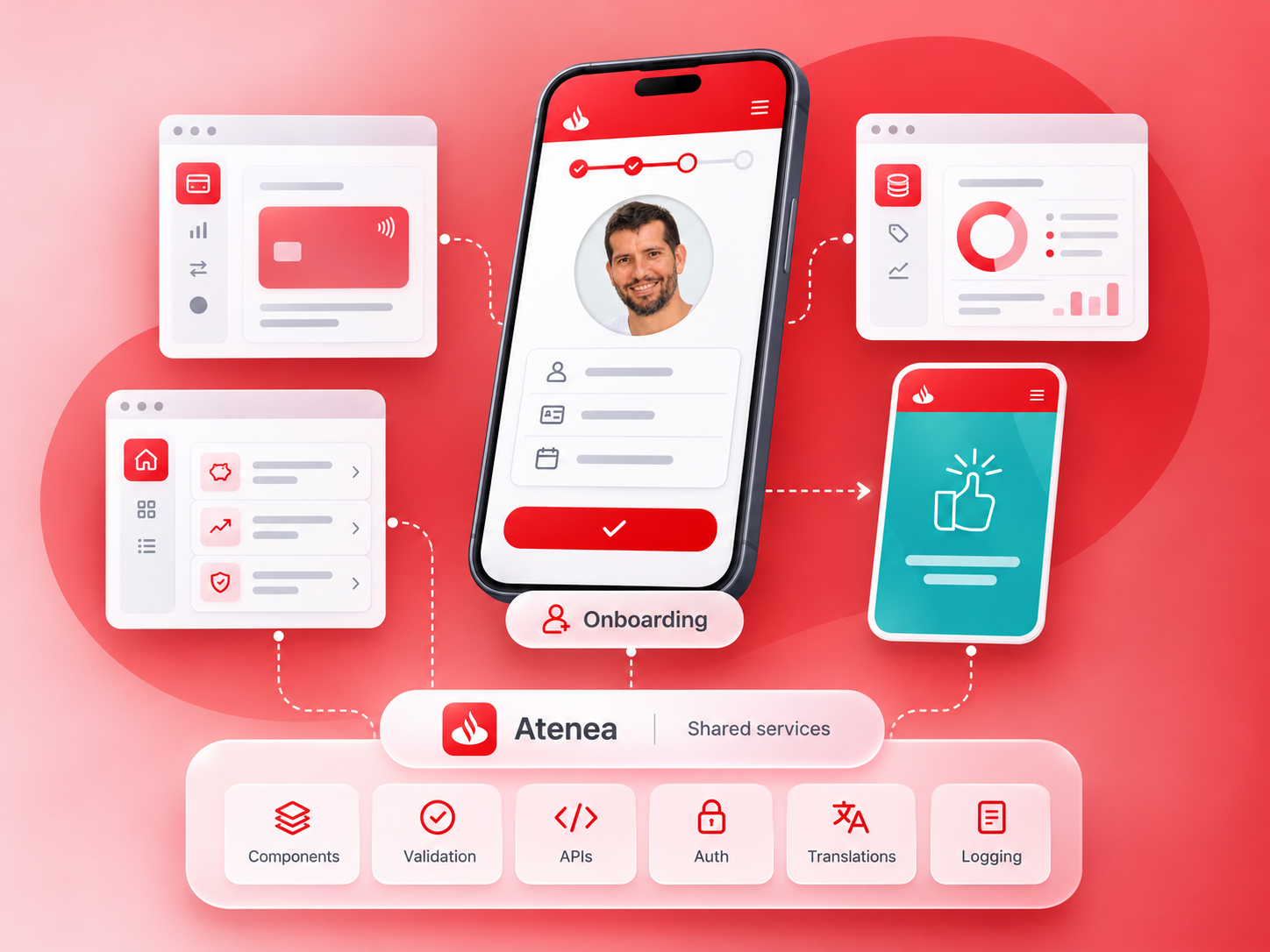
Atenea provided a shared foundation for developing applications without repeatedly rebuilding common infrastructure.
Tap to enlarge
I defined or reviewed most of its frontend architecture and collaborated on backend integration decisions.
The framework combined several capabilities:
- Reusable interface components
- shared UI elements that applications could customize and compose.
- Data management and validation
- consistent handling of application data, including changes held in memory until they were saved or discarded.
- Cross-application communication
- communication between modules running in iframes through
postMessage. - API integration
- a shared REST service layer for communicating with backend systems.
- Common services
- authentication, internationalization, and logging.
Unlike TUBI, Atenea was not intended to prescribe every application flow or business rule. It provided reusable building blocks while allowing teams to develop custom functionality in code.
The framework initially lived in a shared Git repository and later evolved into an npm package, making it easier for applications to consume and maintain a common implementation.
From a framework to an engineering standard
Atenea was adopted rapidly throughout Santander’s branch application ecosystem.
As its capabilities matured, adoption expanded to nearly all branch applications and eventually to customer-facing products.
TUBI was phased out in favor of the new framework.
What began as an effort to improve one internal tool became a shared architectural foundation used across different parts of the bank.
The adoption also demonstrated that greater flexibility did not have to mean abandoning standardization: teams could share infrastructure and technical conventions without forcing different products into the same rigid configuration model.
Enabling banking beyond the branch
When the COVID-19 pandemic began, Santander faced an urgent challenge.
Opening accounts and contracting banking products required customers to visit a physical branch. The existing applications supporting these processes were available only within the bank’s internal network.
The bank needed a new digital channel that could operate entirely online.
I led the team responsible for building the digital onboarding application, working with approximately ten developers alongside QA, designers, functional analysts, and product owners.
Atenea helped accelerate development by providing capabilities we could reuse rather than implementing the frontend foundation from scratch.
The first MVP, focused on opening bank accounts, reached production in approximately three months.
It established Santander’s first channel for opening accounts outside its physical branches, allowing the bank to continue acquiring customers during pandemic-related restrictions.
Simplifying a complex banking process
Opening a bank account involves identity verification, regulatory requirements, financial evaluation, and product activation.
The initial UX proposal closely mirrored the existing branch process, exposing too many steps to the customer.
I worked closely with UX to simplify the journey, reducing the number of visible interactions while keeping the necessary validations and operations behind the scenes.
As the platform evolved, the onboarding process incorporated biometric identity verification, validation against RENAPER, automatic completion of personal information, email verification, and mandatory regulatory declarations, including politically exposed person (PEP) status.
Credit eligibility was assessed through an internal Santander scoring service using information from the BCRA, alongside Veraz checks.
Based on eligibility, customers could choose from the banking products available to them and proceed with activation.
The initial release supported account opening. Later iterations added banking packages and cards, followed by insurance and loans.
The challenge was not only connecting these systems, but making a technically complex process feel straightforward to the customer.
Architecture and delivery
The onboarding application followed a frontend and Backend for Frontend (BFF) architecture.
The BFF connected the customer-facing application with Santander’s internal banking services and external integrations, including the services involved in identity verification and financial evaluation.
I led the frontend architecture and remained hands-on throughout development, contributing code, reviewing pull requests, and coordinating technical decisions with the team.
Working with product, design, and engineering allowed us to balance delivery speed with the requirements of a banking application handling sensitive customer information.
The initial launch was the first milestone of a platform that continued expanding its capabilities after reaching production.
Improving onboarding through experimentation
Reaching production was only the beginning.
We introduced funnel analytics and A/B testing using Google’s analytics tools to understand how customers progressed through onboarding and identify opportunities to reduce friction.
One significant problem emerged during biometric identity verification.
Users frequently struggled to complete facial verification using desktop webcams, resulting in unsuccessful attempts and interruptions to the onboarding journey.
Tap to enlarge
After identifying this issue, we introduced a QR code that allowed customers to continue the biometric step on their smartphones, where camera capabilities were better suited to the verification process.
The change substantially improved biometric verification success rates.
We continued using funnel analysis and experimentation to guide improvements, evolving the customer experience based on observed behavior rather than assumptions alone.
Improving engineering practices
Alongside these projects, I worked on improvements to the bank’s broader engineering environment.
Tap to enlarge
I drove the migration from Team Foundation Server (TFS) to Git, an initiative that began while I was working through Accenture and continued after my direct incorporation into Santander.
The transition required establishing shared practices and helping teams adopt new development workflows. I delivered Git training to developers beyond my own teams.
I also helped improve developers’ workstations, addressing equipment limitations that were affecting productivity.
Other internal training included Angular and a game-development workshop designed to encourage developers to explore unfamiliar problems and solutions outside their usual application work.
As my responsibilities grew, I provided technical guidance across multiple squads, supporting architectural decisions, development standards, priorities, and production operations.
Outcome
My work at Santander contributed to two major changes in its application ecosystem.
Atenea replaced a rigid, increasingly difficult-to-maintain internal platform with a reusable frontend foundation. It was adopted across nearly all branch applications, expanded into customer-facing products, and enabled TUBI to be retired.
Digital onboarding introduced a new channel for opening bank accounts without visiting a branch. Its first MVP reached production in approximately three months, allowing Santander to continue acquiring customers during the pandemic.
The platform subsequently expanded to additional banking products and evolved through analytics-driven improvements, including a substantial increase in biometric verification success after introducing a mobile continuation flow.
Beyond these projects, I contributed to engineering practices, technical training, and architectural leadership across multiple teams.
Looking back
The most important decision was recognizing when improving an existing system was no longer the right solution.
Replacing TUBI’s growing collection of exceptions with a flexible shared framework required more than architecture. It required challenging the original approach, securing support, building a team, and earning adoption across the organization.
The onboarding project later demonstrated the value of that investment. A framework created to solve recurring development problems also helped the bank respond quickly to an unexpected business challenge.
It reinforced an approach I continue to value: understand the problem before choosing the solution, build foundations that others can extend, and keep improving products after they reach production.
What colleagues say

Daniel Clas
Tech Lead
Worked with Diego at Santander Tecnología
Besides being a good friend, Diego is the best developer I have worked with, hands down. In both companies we shared time in, Diego was a technical leader working above me and the rest of my peers. We all looked up to him as someone with a deep technical expertise and the ability to tackle any problem thrown his way. He does the work of 5 people and know front-end technologies better than anyone I know. For these reasons he's someone I truly recommend and will always want in my team.

Hernán Husulak
Project Manager
Managed Diego at Santander Tecnología
Tuve la fortuna de contar con Diego como Arq. Front para el diseño y desarrollo de una aplicación para la gestión de productos, constuida con Angular 7 y Java 1.8. Destaco su compromiso, profesionalidad, capacidad, dotes de liderazgo y coaching con personas de menor experiencia. Sin dudas lo sumaria nuevamente en cualquier equipo de trabajo a mi cargo.